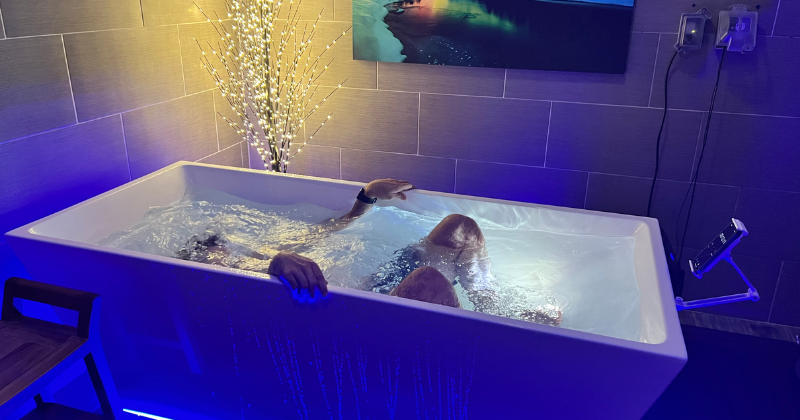
Most people walk into their first float session expecting to feel weird.
They've heard about the salt. The darkness. The silence. And they're not totally wrong — it is all of those things. But what they don't expect is what happens after they stop fighting it.
Around the 20-minute mark, something shifts.
The tension you've been carrying in your shoulders — the kind you stopped noticing months ago — starts to dissolve. Your mind, which has been running a background program of emails and to-do lists and half-finished thoughts, goes quiet. Not forced quiet. Actually quiet.
"That's not a coincidence. That's your nervous system shifting gears — and research is starting to show why."
What's Actually Happening in Your Brain
Float therapy — also called sensory deprivation or REST (Restricted Environmental Stimulation Therapy) — works by removing the two things your nervous system spends the most energy on: gravity and external stimulation.
Your brain is constantly processing. Light, sound, temperature, the weight of your body against a surface — every one of those inputs requires neurological resources. When you remove all of them at once, something remarkable happens: your brain shifts from beta waves (active, alert thinking) into theta waves.
Theta waves (4-8 Hz) represent the brain state between waking and sleeping — the state associated with deep meditation, creative insight, and deep rest. Most adults spend little time in theta because constant stimulation keeps the brain in beta. Research suggests floating may be one of the easier non-pharmacological ways to encourage theta states.
Theta is associated with creative thinking and deep, dreamlike rest. It's often linked to the state athletes describe as "in the zone." Most of us spend almost no time there because we're constantly bombarded with stimulation.
For many people, floating is one of the easiest ways to get there — and it tends to get easier with practice.
This isn't a new idea. In the 1960s and '70s, psychologist Peter Suedfeld studied what he called REST (Restricted Environmental Stimulation Therapy) in dark, quiet rooms, and found that — contrary to the fears of the time — most participants found it relaxing and wanted to come back. Researchers later called the float tank version "Flotation-REST." Since around 2016, wireless EEG has let scientists watch brain activity during a float in real time instead of only before and after.
The Physical Side
The water in our float tanks at Lost in Float is kept at the exact temperature of your skin surface. That's not an accident. When water matches your skin temperature, your brain stops registering the boundary between your body and the water. You stop feeling where you end and the water begins.
Studies published in journals including PLOS ONE (Feinstein et al., 2018) found that a single float session produced significant short-term reductions in anxiety, stress, muscle tension and blood pressure, along with improvements in mood. In Feinstein's work, the people who arrived most anxious tended to show the biggest drop — many ending the session about as relaxed as everyone else. (For a deeper look at the environmental details that make this work — water chemistry, room temperature, soundproofing — see what makes a great float experience.)
What to Expect Your First Time
Here's the honest truth about your first float: the first 10-15 minutes might feel strange. Your mind will try to give you things to think about. You'll notice every itch, every sound, every thought.
That's normal. That's withdrawal from constant stimulation. Keep going.
Around minute 15-20, most people cross a threshold. The mind stops fighting the quiet and starts inhabiting it. That's when the magic happens.
A typical 60-minute float looks like this:
- Minutes 0-15: Adjustment period. Your mind is still active. Focus on your breathing.
- Minutes 15-30: The transition. Thoughts slow, body fully relaxes, you lose track of where your body ends.
- Minutes 30-55: The theta state. Deep, effortless relaxation. Some people experience visual imagery. Many report this as the best they've felt in years.
- Minutes 55-60: Gentle music fades in to bring you back. You control the lights inside the tank — turn them on when you're ready, or stay in the dark a little longer. There's no rush.
Most people enjoy their first float. If yours felt a little restless, or like you never fully let go, that's okay too — some Type A personalities find it takes 2-3 sessions for the nervous system to fully settle in, and many tell us float number 3 is where it really clicks. Each float tends to go deeper than the last. (More on how the practice deepens over time: first float vs 10th float.)
By the time your session ends, most first-timers describe feeling like they've had the deepest sleep of their lives — without having slept at all.
Who Benefits Most
Float therapy isn't just for stressed-out executives and spiritual seekers (though many of them love it). In Lincoln NE, guests often tell us it helps with:
- Athletes — research suggests floating may support perceived recovery and sleep quality after hard training
- Stress and anxious minds — research suggests floating may reduce short-term anxiety, and the quiet environment can feel like a genuinely safe space to downshift
- Achy bodies — many guests with back or joint discomfort tell us the weightless environment brings real relief
- Creative professionals — the theta state may help open up problem-solving and creative thinking
- Anyone who just can't turn their brain off — many people who struggle with meditation find floating easier
Float therapy is a wellness practice, not a treatment for anxiety, PTSD, chronic pain, fibromyalgia or any other condition. If you're managing one of those, talk to your doctor about how floating fits alongside your care.
How Often Should You Float?
One session gives you a powerful reset. But the real benefits compound with regularity.
Most of our members at Lost in Float float 2-4 times per month and report that by their third or fourth session, they hit the theta state faster, go deeper, and carry the benefits longer into the week.
Ready to experience it yourself?
Your first float is waiting at Lost in Float in Lincoln NE — 60 minutes, $75. Book online in under 60 seconds.
Book your first float → See membershipsThe Bottom Line
Float therapy is not a luxury. It's a recovery tool that your brain and body are genuinely starved for in a world that never stops making noise.
If you're in Lincoln NE and you haven't tried it yet, your first float is waiting for you.
Lost in Float is located at 8244 Northern Lights Dr, Lincoln NE. Open Tuesday–Sunday 9am–9pm. Call or text 531.289.7739, or book your 60-minute float ($75) online.