Chronic pain doesn't take a day off. For people living with fibromyalgia, arthritis, persistent back pain, endometriosis, or migraines, most moments involve some degree of managing — compensating for discomfort, adjusting how you sit or move, rationing your energy around what hurts.
For many people living with chronic pain conditions, float therapy has become one of the most meaningful parts of their management routine. What makes it different: it removes the apparent gravitational load on your body almost completely. For an hour, your joints bear no weight, your muscles hold nothing, and many people find the constant pain signals that come from a body working against its own weight quiet down.
For many people with chronic pain, that hour is unlike anything else in their week.
Why Gravity-Free Relief Is Different
Most chronic pain has two components:
- The structural source — inflammation, joint damage, nerve involvement.
- The nervous system's response to that source — which over time can become its own driver of pain.
This second component involves a process called central sensitization — the nervous system becomes increasingly responsive to pain signals, amplifying them beyond what the original stimulus would warrant. This is particularly well-documented in fibromyalgia.
Research suggests float therapy may help with the nervous system component. By reducing sensory input to near-zero — no apparent gravity, no sound, no light, water at skin temperature — it may quiet the afferent signals that keep the sensitized nervous system on high alert. The brain, receiving very little to process, may ease off the amplification.
For more on what's happening neurologically — including the shift from beta to theta brain states that quiets the pain-amplifying nervous system — see Your Brain on Float Therapy.
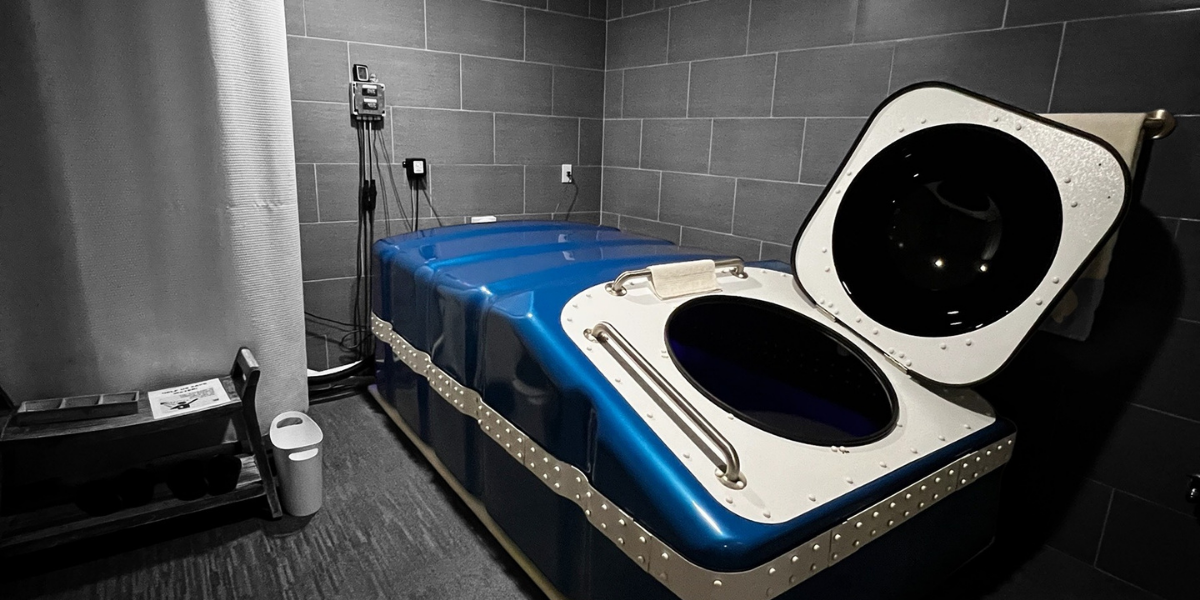
Float tanks at Lost in Float use approximately 1,300 pounds of magnesium sulfate (Epsom salt) per tank. Magnesium is involved in over 300 enzymatic processes in the body, including the regulation of nerve transmission and muscle contraction.
Two things to know about how magnesium works in a float tank:
- Don't count on skin absorption. There isn't good evidence that meaningful magnesium crosses the skin into the bloodstream.
- The soak itself is what people feel. Warm, dense, buoyant water lets muscles let go — which is part of why Epsom salt baths have been used for muscle soreness for generations.
During a float, your entire body is supported by water far denser than a typical bath. For many people with chronic pain, that muscle relaxation is one of the most immediate and noticeable parts of the session.
The mechanical side: spinal decompression
Beyond the nervous system effects, there's a straightforward mechanical dimension. When you're floating, the spine can lengthen naturally as gravitational compression is removed.
For people with back pain, herniated discs, or facet joint issues, many guests tell us this brings noticeable physical relief during and after the session — without requiring any technique or equipment, just buoyancy. How quickly and how much that translates to lasting change varies by person and the underlying cause of the pain.
What the Research Shows
The evidence base for float therapy and chronic pain has grown considerably over the last two decades, with the strongest body of research focused on fibromyalgia. Here's what the most rigorous studies have found:
Studied float REST in chronic pain patients and found significant reductions in pain, anxiety, and depression — a pattern that makes sense given that all three are interconnected in fibromyalgia's presentation. Effects were not limited to the session itself; participants reported improvements that persisted between sessions and accumulated with regular practice. View on PubMed →
Out of the Laureate Institute for Brain Research in Tulsa, this paper documented significant short-term reductions in anxiety and improvements in mood after a single float session, with effects persisting days later. This work has set the modern research standard for what floating actually does to the nervous system. View on PubMed →
Analyzed 63 studies covering 1,838 participants — the most comprehensive look at flotation research published. Strong evidence emerged across nine categories: pain, athletic performance, physiology (cortisol and blood pressure reduction), stress, anxiety, sleep, consciousness, psychology, and creativity. The pain literature alone now includes 10+ studies showing meaningful effects in chronic tension headaches, stress-induced muscle pain, and whiplash-associated disorders. View full text →
For conditions like arthritis, the research is thinner but consistent with what would be predicted from the mechanism: removing joint loading may ease pain associated with that loading. The question isn't whether floating will feel good — it commonly does — but whether the benefit persists long enough to be worth incorporating regularly.
For many members who float for pain, the answer is yes — particularly when combined with red light therapy, which has emerging research on supporting the body's inflammation response at the cellular level.
Early studies and consistent clinical experience are encouraging. The strongest benefits documented in the literature are in the short term and with regular use — longer-term data and larger randomized trials are still developing. The research community continues to build on this foundation, and the direction of findings so far has been encouraging across conditions and study designs.
Autoimmune & Inflammatory Conditions: An Honest Look
If you have lupus, rheumatoid arthritis, multiple sclerosis, Hashimoto's, Crohn's, ulcerative colitis, psoriasis, or any other autoimmune condition, you've likely seen wellness centers claim that floating "boosts immunity" or "reduces inflammation."
We're going to give you the honest picture instead. For autoimmune patients especially, vague claims aren't just unhelpful — they can be misleading in ways that affect medical decisions.
What the research actually shows
The most comprehensive systematic review of flotation research to date — the 2025 BMC Complementary Medicine and Therapies review — analyzed 63 studies across 1,838 participants.
Strong evidence emerged in: pain, athletic performance, physiology (cortisol and blood pressure reduction), stress, anxiety, sleep, and consciousness.
Autoimmune disease was not a category — because there is not yet a meaningful body of peer-reviewed research on flotation REST for specific autoimmune conditions like lupus, MS, RA, or inflammatory bowel disease.
You may see other websites cite Ruzyla-Smith & Barabasz (1993) as evidence that floating "enhances T-cells, B-cells, and immune function." Worth knowing what that study actually is:
- It's a book chapter, not a peer-reviewed journal article.
- It used a small sample of healthy subjects, not autoimmune patients.
- It measured acute immune cell counts after a single session.
- It has never been replicated at the scale needed to support broad immune claims.
It does not show that floating treats, modifies, or improves autoimmune disease. Period.
What IS supported — the cortisol pathway
Here's what the research does support, and why floating may still be genuinely helpful for many people with autoimmune conditions, even without direct disease-specific studies:
- Flotation reliably reduces cortisol. One of the most consistently documented effects across the entire flotation literature, including the van Dierendonck & te Nijenhuis 2005 meta-analysis and the Feinstein 2018 LIBR work.
- Stress and elevated cortisol worsen autoimmune disease activity. Stress is one of the most consistent flare triggers patients with lupus, RA, MS, IBD, and psoriasis report. This is established in the autoimmune literature, not the flotation literature.
- The chain is plausible. If floating reduces stress and cortisol, and stress and cortisol drive flare activity, then floating may indirectly help reduce flare frequency or severity.
That's a reasonable mechanism with indirect support — not direct evidence that floating treats autoimmune disease. It's why we list autoimmune conditions as something float therapy may support through stress reduction and nervous system regulation, rather than something it treats directly.
What members with autoimmune conditions tell us
Anecdotally, members with various autoimmune conditions have reported that regular floating helps them:
- Feel calmer day-to-day
- Sleep better
- Manage flare-related anxiety
- Tolerate flare periods more comfortably
Some report fewer flares; some don't. We're not going to pretend these reports are research — they're observations from a self-selected population. They're meaningful, but they're not the same as a randomized controlled trial.
- Floating is not a treatment for your condition. It's a stress and recovery tool that may complement your medical care. Continue all prescribed medications, treatments, and follow-ups with your specialist.
- Skin involvement matters. Active psoriasis flares, eczema breaks, lupus rashes with broken skin, or any open lesions — the salt water will sting. Wait until skin is intact, or talk to us about whether to skip a session.
- Immunosuppressive medications are common. While our tanks are sanitized between every session and the high salt content makes the water naturally hostile to most pathogens, ask your specialist about precautions specific to your medication regimen.
- Tell your provider you're floating. Not because there's a known interaction, but because your specialist tracking flare patterns may want to know what's changing in your routine.
- Don't change medications based on how you feel after a float. If floating helps and you feel meaningfully better, that's a conversation to have with your prescribing provider — not a reason to skip doses.
If you've been told by other wellness centers that floating will "fix your inflammation" or "balance your immune system" — be cautious. Those phrases sound good and don't mean much.
Research suggests flotation can be a useful tool for stress, pain, sleep, and nervous system regulation. For autoimmune disease specifically, that's where the case ends and the honesty begins.
Specific Conditions — What to Expect
"He hadn't been able to lie flat on his back in years. In the float tank, the weight just disappeared. He cried. That's what zero apparent gravity actually means for someone in pain."
What Members with Chronic Pain Tell Us
"I have psoriatic arthritis and the cold water immersion feels so great on my inflamed joints. The sauna is SO CLEAN and actually hot."
"Lost in Float has provided me a source of healing and regeneration beyond my expectations. I absolutely love to float. It's very clean, safe and inviting here."
"For me, this place is a must and I love it — my old body looks forward to every visit and my ADHD mind craves the release."
The pattern we hear most from members managing chronic pain is consistency. One session often provides meaningful acute relief. A regular practice — two to four times per month — is where members start to describe it as genuinely changing how they manage their condition week to week.
What to Realistically Expect
Results vary — and it's worth being honest about that upfront. Two patterns are common:
- Some people experience profound relief after a single session.
- Others notice subtler, cumulative benefits that build over several weeks of regular floating.
Neither experience is wrong. Factors that influence your response include:
- The type and source of your pain
- Your baseline stress and nervous system state
- Your expectations going in
- How consistently you float
People whose pain has a strong central sensitization component — fibromyalgia, widespread tension, stress-driven pain — may respond particularly well. People whose pain is primarily structural may experience more relief in the tank than lasting change between sessions, though many tell us regular floating shifts their baseline over time.
Most people enjoy their first float. If yours feels less dramatic than you hoped, that's not a sign floating isn't for you — many people find each session goes even deeper than the last.
The Bigger Picture — Sleep, Mental Health, and the Pain Cycle
Chronic pain rarely exists in isolation. There's a self-reinforcing cycle most people in chronic pain know intimately:
- Pain disrupts sleep
- Poor sleep raises cortisol
- Elevated cortisol amplifies pain signals
- More pain further disrupts sleep
The cycle also feeds anxiety and depression, which lower pain thresholds, which intensifies the pain experience. This is well-documented and genuinely hard to interrupt with any single intervention.
Float therapy addresses several points in that cycle simultaneously:
- Sleep: Research suggests floating may support sleep quality — reduced time to fall asleep, improved depth, and lower cortisol levels post-session. For people with chronic pain, better sleep is often the most underestimated part of pain management. Less-disrupted sleep means a more regulated nervous system the next day, which may mean lower pain sensitivity.
- Anxiety and depression: The Kjellgren study and the more recent LIBR work both documented reductions in anxiety and depression alongside pain — not as a side effect, but as part of the same nervous system response. Addressing the emotional component of chronic pain is not separate from addressing the pain itself.
- Nervous system regulation: Research suggests float therapy may shift the autonomic nervous system toward parasympathetic dominance — rest and recovery mode. For people in chronic pain whose nervous system is running in a near-constant state of alert, many tell us this shift carries well beyond the session itself.
Who Shouldn't Float (Or Should Wait)
Float therapy is gentle and well tolerated by most people, including most people with chronic pain conditions. There are, however, a few situations where you should hold off or check with your provider first.
- Recent surgery — particularly orthopedic surgery with hardware that hasn't fully integrated, or any procedure where your surgeon has restricted water immersion. Established post-surgical cases (months or years out) are generally fine.
- Active skin infections, open wounds, or significant broken skin — the salt will sting badly and you risk introducing bacteria. Wait until skin is healed.
- Recent ear surgery or active ear infection — water entering the ear canal could cause complications. We provide earplugs, but with active issues it's better to wait.
- Uncontrolled epilepsy — many people with epilepsy float comfortably, but if seizures are not well-controlled, talk to your neurologist first.
- High-risk pregnancy or pregnancy complications — many people with uncomplicated pregnancies float comfortably with their provider's OK, but always coordinate with your OB if there are complications.
- Active psychiatric crisis — sensory deprivation can sometimes amplify acute states. If you're in crisis, this is not the right tool right now. Reach out to a crisis line or your provider.
- Severe claustrophobia — most claustrophobia is manageable in our open float suites, but if it's severe and untreated, talk to us first so we can walk you through what to expect.
Practical Tips for First-Timers with Chronic Pain
A few things that make a meaningful difference if you're coming in with a pain condition:

- Earplugs and neck pillow: We have both available. Earplugs help with any residual sound sensitivity. If neck or head positioning is an issue — common with cervical pain or tension headaches — ask for a neck pillow when you arrive. It sits at the waterline and takes the head's weight completely.
- You can get out anytime: The lid opens at your control, the light is yours to turn on, and there's no commitment to stay for the full session. Knowing you can leave often makes it easier to stay. Most people who think they'll need to get out early find they don't.
- Don't fight the first 15 minutes: If you're in pain, your nervous system is probably running hot. The first part of a float session is often when that becomes most apparent — you notice more, not less. This settles. It almost always settles. Let it run.
- Post-float care: Drink water after your session. Move gently — a short walk is ideal. Avoid scheduling demanding meetings, workouts, or stressful commitments immediately after. The calm that follows a float is worth protecting. Many members find that giving themselves an hour of transition time makes a significant difference in how long the benefits last.
- If you can't relax: That's okay — it usually gets easier with each session. Your nervous system is learning something new — how to do very little. That's a skill, and it gets easier quickly.
Pairing Float Therapy with Other Services and Medical Care
Float therapy works well as a standalone practice and even better as part of a broader approach to pain management. It's meant to complement medical care, not replace it.
Medical care pairings
- Physical therapy: Floating can complement PT — the muscle relaxation and nervous system quieting effects can make PT exercises more effective when done in proximity to a float session. Some members float the day before or after PT appointments.
- CBT for pain (pain psychology): Cognitive behavioral therapy for chronic pain works partly by addressing central sensitization and emotional amplification. Float therapy addresses the same component physiologically. The two approaches are complementary.
- Medications: Floating doesn't replace any prescribed treatment. If you take pain medications, let your prescribing provider know you're floating, and talk with them before changing anything about your medications.
Other Lost in Float services that pair well
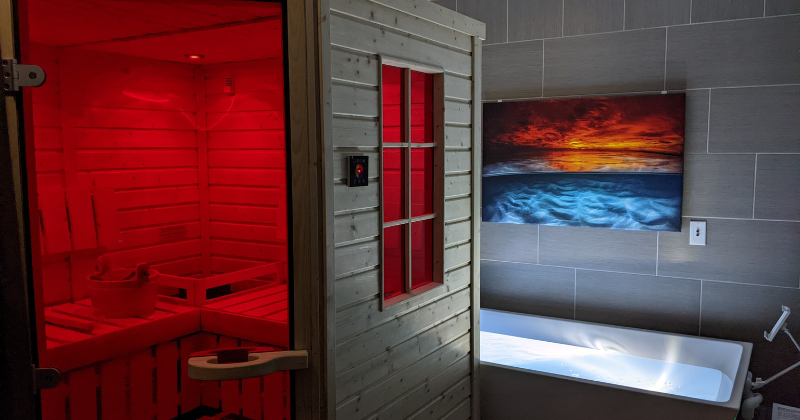
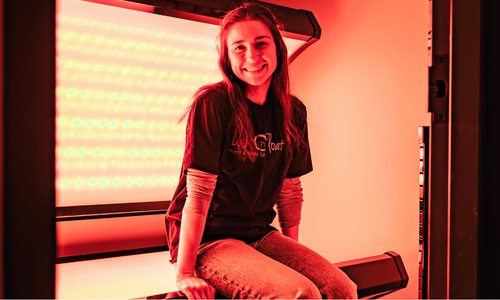
- Red light therapy — emerging research suggests photobiomodulation may support the body's inflammation response at the cellular level. Many members with inflammatory conditions like rheumatoid arthritis do red light right before a float: red light for the cellular side, the float for the gravitational and nervous system side.
- Fire & Ice (Sauna + Cold Plunge) — a private room with a 195°F sauna and a 45°F cold plunge, alternating vasoconstriction and vasodilation (45 min $49 / 60 min $59). Many members with arthritis and fibromyalgia find it complements their float practice.
- Immersion Room — a private room with a hot plunge and a 45°F cold plunge (20 min $25 / 45 min $49). Research suggests cold water immersion may support the body's inflammation response; many members with achy joints like it before their float.
Book your first float in Lincoln
Zero apparent gravity. 1,300 lbs of Epsom salt. Private suite, sanitized between every session. 60 minutes, $75. Family-owned since 2017.
Book now → See membershipsFrequently Asked Questions
- Kjellgren A, Sundequist U, Norlander T, Archer T. Effects of flotation-REST on muscle tension pain. Pain Research and Management. 2001;6(4):181-189. View on PubMed →
- van Dierendonck D, te Nijenhuis J. Flotation restricted environmental stimulation therapy (REST) as a stress-management tool: A meta-analysis. Psychology & Health. 2005;20(3):405-412.
- Bood SÅ, Sundequist U, Kjellgren A, Nordström G, Norlander T. Effects of flotation rest on stress related muscle pain: are 33 flotation sessions more effective than 12 sessions? Social Behavior and Personality. 2007;35(2):143-156.
- Jonsson K, Kjellgren A. Promising effects of treatment with flotation-REST as an intervention for generalized anxiety disorder. BMC Complementary and Alternative Medicine. 2016;16:108. View on PubMed →
- Feinstein JS, Khalsa SS, Yeh HW, Wohlrab C, Simmons WK, Stein MB, Paulus MP. Examining the short-term anxiolytic and antidepressant effect of Floatation-REST. PLOS ONE. 2018;13(2):e0190292. View on PubMed →
- Loose LF, Manuel J, Karst M, Schmidt LK, Beissner F. Flotation Restricted Environmental Stimulation Therapy for chronic pain: A randomized clinical trial. JAMA Network Open. 2021;4(5):e219627. View on PubMed →
- Loose LF, Manuel J, Karst M, Beissner F. A systematic review of flotation-restricted environmental stimulation therapy (REST). BMC Complementary Medicine and Therapies. 2025. View full text →
A note on medical care: Float therapy is a wellness practice grounded in published research. It is not a replacement for medical treatment, physical therapy, pain psychology, or prescribed medications — and it works best as part of a broader approach to managing chronic pain, not instead of one. If you are in an active pain crisis, contact your provider directly — float therapy is not appropriate as a substitute for emergency medical evaluation. If you are under the care of a provider for a pain or autoimmune condition, we encourage you to continue that care and bring floating into the conversation as a complement to what you're already doing.